Everything You Need to Know About Thatched Roof Installation at Home
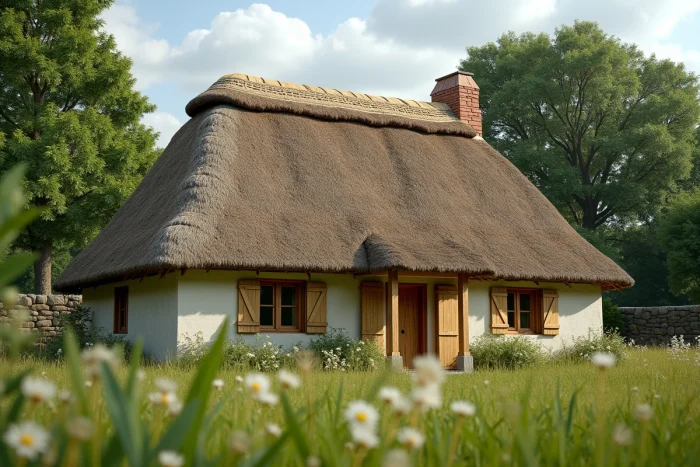
A thatched roof is a plant-based covering made of tightly bound bundles of stems (reed, rye, broom) fixed to a suitable framework. This technique, far from being a folkloric relic, is experiencing a resurgence of interest driven by the requirements for bio-sourced construction and regional subsidies, particularly in Occitanie since 2024.
Thatch and passive house RE2020: a still little-known hybrid use case
The environmental regulation RE2020 pushes builders towards bio-sourced materials capable of storing carbon. Thatch ticks this box, but installing a plant cover on a passive house raises a problem that traditional guides do not address: the management of the dew point in a hybrid insulating complex.
In a RE2020 construction, the building envelope must be airtight. A thatched roof, being naturally permeable to water vapor, works in the opposite way to a vapor barrier. To reconcile the two logics, the technical solution consists of separating the covering layer (the thatch) from the thermal insulation layer, interposing a highly vapor-permeable under-roof screen (HPV).
Specifically, the framework first receives a bio-sourced insulation (wood fiber, hemp wool) between the rafters, then the HPV screen, followed by battens on which the thatcher fixes the bundles. This assembly allows the thatch to dry freely to the outside while maintaining the thermal performance required by RE2020. To delve deeper into the steps to make a thatched roof, one must first understand this logic of successive layers.
Framework and minimum slope of a thatched roof
Before touching a single bundle of reed, the framework must meet a non-negotiable constraint: the slope of the roof must be sufficient to drain water by gravity. The professional rules for thatch impose a minimum slope of 40 to 45 degrees. Below this, water stagnates between the stems and accelerates degradation.
The load-bearing structure consists of purlins, rafters, and battens (or horizontal strips) spaced regularly. The wood used must be dry and treated against wood-eating insects, as thatch retains surface moisture during rainy episodes. Wood that is too fresh risks deforming under the weight of the covering, which is significantly heavier than a tile covering.
Specific case of renovations
On an old building, the existing framework does not always have the required slope. A thatcher then proceeds to a framework adjustment: raising the ridge, modifying the angle of the rafters, or even completely replacing the structure. This step often represents the heaviest budget item of the project.
Material choice: reed, rye, or broom
The term “thatch” refers to a type of covering, not a single material. Three plants dominate the market in France, each with distinct properties.
- Reed (Phragmites australis) is the most commonly used material today. Its hollow and rigid stems offer the best resistance to rain and UV rays. Most reed comes from Camargue or is imported (Eastern Europe).
- Rye straw, being more flexible, is suitable for rounded shapes and complex roofs. The French Federation of Thatchers has documented lifespans exceeding 50 years for properly bundled and treated rye, thanks to modern bundling techniques.
- Broom, used in certain regions of the Massif Central, remains marginal. Its manual harvesting and limited supply make it a niche choice, reserved for heritage restorations.
The choice of plant depends on the local climate, the shape of the roof, and the desired aesthetic outcome. In areas highly exposed to wind and rain, reed will be more durable than rye.
Thatching technique on battens
The installation is always done from the bottom up, row by row. Each bundle is positioned stem down, with the thick part (the butt) facing outward. The thatcher attaches the bundles to the battens using stainless steel wire or plant ties, depending on the regional technique.
Fixation and tightening
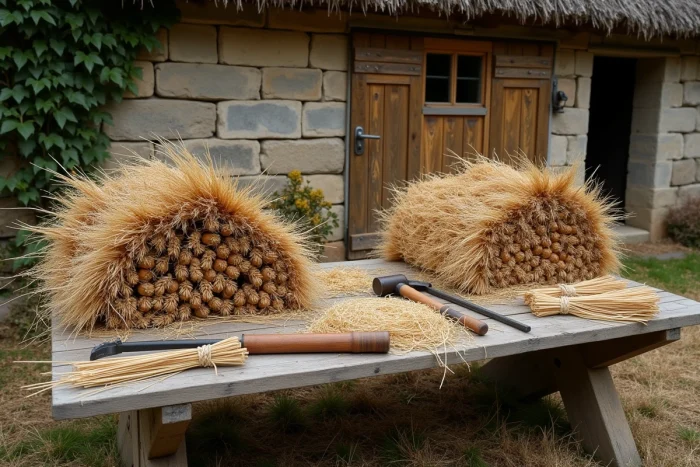
The tightening of the bundles directly affects the watertightness. A poorly tightened bundle allows water to penetrate between the stems, which causes accelerated rotting from the inside. The thatcher uses a leggett (flat wooden mallet) to compact each row before fixing the next. This action, repeated across the entire surface, ensures a uniform density.
The final thickness of the covering varies depending on the material and the region, but it generally reaches several tens of centimeters. This thickness gives thatch its natural thermal and acoustic insulation properties.
Ridge: the critical point
The ridge, the junction line at the top of the roof, is the most vulnerable area. Two techniques coexist: the earthen ridge (a mixture of clay and straw placed on the last rows) and the tied thatch ridge. The earthen ridge offers better longevity but requires more regular maintenance, as the clay cracks due to freezing. The tied ridge, more common in northern France, is easier to replace.
Regulations and procedures for a thatched roof
Any thatching project requires a building permit or a prior declaration of works depending on the scale of the project. The Local Urban Plan (PLU) of the municipality may authorize, impose, or prohibit thatch: some protected areas require it to respect the built heritage, while others refuse it due to fire risk.
- Check the PLU before launching any technical study.
- Consult the professional rules for thatching, which serve as a technical reference in the absence of a complete specific DTU.
- Plan for fireproof treatment if the building is located less than eight meters from a neighboring construction, in accordance with local fire safety regulations.
In Occitanie, the CAUE supports project holders with updated technical sheets. Regional subsidies for bio-sourced materials can cover part of the additional cost associated with thatch compared to conventional roofing.
A thatched roof remains a handcrafted work whose quality depends almost entirely on the skill of the thatcher. No industrial shortcut compensates for poor tightening or a shoddy ridge. Before choosing a provider, checking their references on similar projects and their knowledge of the specific material (reed, rye) remains the most useful precaution.