
What are the best fruits to consume for successful muscle gain?
Fruits occupy an ambiguous place in mass gain-oriented dietary plans. Often relegated to the status of “healthy snack,” they are rarely analyzed in terms of their actual contribution to caloric surplus and muscle recovery. Their density in carbohydrates, micronutrients, and fiber makes them allies not to be overlooked, provided one knows which ones to prioritize and when to consume them.
EU Regulation 2024/2865 and whole fruits: what changes for athletes
Since January 2025, the EU Regulation 2024/2865 gradually restricts the use of artificial sweeteners in fruit-based protein smoothies marketed in Europe. This regulatory evolution pushes manufacturers to reformulate their products, but it also has an indirect effect on weight training practitioners.
“Mass gainer” smoothies based on fruits, which often contained sweeteners or added sugars to enhance palatability, must now rely more on unprocessed whole fruits. For consumers, this means that the nutritional quality of these drinks approaches what one would obtain by blending fresh fruits with a protein source.
This regulatory framework makes the choice to work directly with raw fruits even more relevant. Preparing one’s own snacks or smoothies allows for better control over carbohydrate and calorie intake without relying on industrial formulations that are in transition. To identify the best fruits for mass gain, one must cross two criteria: caloric density and richness in micronutrients useful for recovery.
Caloric fruits for mass gain: which ones provide a real surplus
Not all fruits are equal when the goal is to increase daily caloric intake. Some have a significantly higher energy density than average, making them particularly suitable for mass gain phases where every meal counts.
Fresh fruits with high energy density
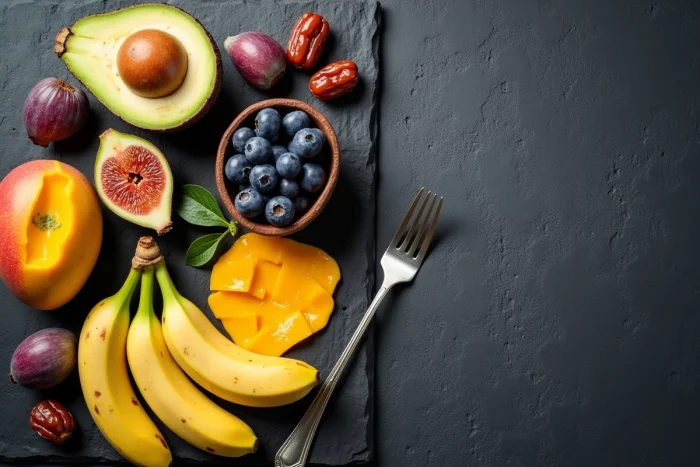
The banana remains the most cited fruit in this context, and for a simple reason: it combines fast carbohydrates, potassium, and convenience. It is easy to transport, digests quickly, and integrates into a post-workout shake without preparation.
The avocado, although often classified as a vegetable in cooking, is botanically a fruit. Its high content of good-quality fats makes it a remarkably effective tool for caloric surplus. It also provides fiber that slows down the absorption of carbohydrates consumed alongside.
Dried and dehydrated fruits: the most underestimated caloric lever
Dates, dried figs, and raisins concentrate natural sugars in a reduced volume. This is a direct advantage for those who struggle to eat enough: a handful of dates can represent a caloric intake equivalent to a small meal.
- Dates pair well with almond butter or cottage cheese to combine carbohydrates and proteins in the same snack.
- Dried coconut provides medium-chain saturated fats, a source of quickly mobilizable energy during exertion.
- Dried apricots provide iron and beta-carotene, two elements often deficient in athletes in caloric surplus who neglect dietary variety.
Mass gain for the vegetarian ectomorph: adapting fruits to a fast metabolism
Classic nutritional advice for mass gain often assumes unlimited access to animal proteins and a “standard” metabolism. For a vegetarian ectomorph whose basal metabolism is hyperactive, the strategy must differ on several points.
The first obstacle is food volume. A fast metabolism burns calories faster, which requires eating more. Whole fruits, rich in fiber and water, fill the stomach without always providing enough calories. This is where dried fruits and homemade smoothies become particularly valuable.
A smoothie combining banana, dates, peanut butter, and enriched plant milk can achieve a significant caloric density in an easy-to-ingest volume. For a vegetarian, this type of preparation effectively replaces industrial gainers, often formulated with whey.
Timing and frequency for fast metabolisms
Spreading fruit intake throughout the day rather than concentrating it around workouts helps maintain a steady flow of carbohydrates. Three to four servings of fruit per day, with at least one in dried or blended form, prevent the energy dips typical of ectomorphs.
The available data do not allow for precise quantification of the advantage of one fruit over another for this specific profile. However, the principle remains constant: favor fruits with high caloric density and systematically combine them with a source of plant-based protein (nuts, seeds, legumes) to maximize protein synthesis.

Fruits and muscle recovery: beyond simple carbohydrates
Reducing fruits to their sugar content would overlook their contribution to recovery. The vitamins, antioxidants, and minerals they contain play a role in repairing muscle fibers after exertion.
Fruits rich in vitamin C (kiwi, citrus, berries) support collagen synthesis, a structural protein of tendons and connective tissues often stressed in weight training. Berries, in particular, provide polyphenols whose role in reducing post-exercise inflammation is the subject of increasing research.
- Kiwi combines vitamin C and soluble fiber, making it an interesting fruit at the end of a meal to enhance nutrient absorption.
- Blueberries are among the most antioxidant-dense fruits, useful when training volume increases.
- Pineapple contains bromelain, an enzyme that aids protein digestion, a direct asset for a diet rich in plant proteins.
Fruits do not replace a structured caloric surplus, but they enhance its quality. A mass gain plan that includes two to four servings of varied fruits per day, combining fresh and dried fruits, meets both the need for quick energy and protective micronutrients. The final choice depends on metabolic profile, dietary constraints, and individual digestive tolerance.