What will be the men’s beard trends to adopt in 2026?
The men’s grooming market is going through a correction phase. After a decade dominated by long and full beards, signals picked up from barbers and in the specialized press point towards shorter, more styled looks, sometimes even a return to a clean-shaven face. Professional constraints in certain sectors are accelerating this shift. Here’s what the beard trends for 2026 look like.
Structured short beard: the style that is taking over in the professional world
A factor rarely highlighted in style guides actually influences the choices of millions of men: hygiene and presentation rules at work. In North America, several hospital networks and restaurant chains have tightened their personal appearance policies between 2023 and 2025.
Kaiser Permanente, a large American hospital network, updated its “Personal Appearance Policy” in April 2024 to specify that all beards must be short and compatible with protective equipment.
This constraint is not limited to health or food service. It is gradually influencing the dress codes of other sectors where wearing masks or hairnets remains common. The result is straightforward: very long beards are becoming a barrier to employment in these environments, and the structured short beard is gaining ground by default.
For men who wish to follow the men’s beard trends of 2026, this professional context should be considered even before choosing a style. Length is no longer just a matter of aesthetics; it is also a matter of compatibility with one’s work environment.
Full shave and three-day beard: the return of the clean-shaven face
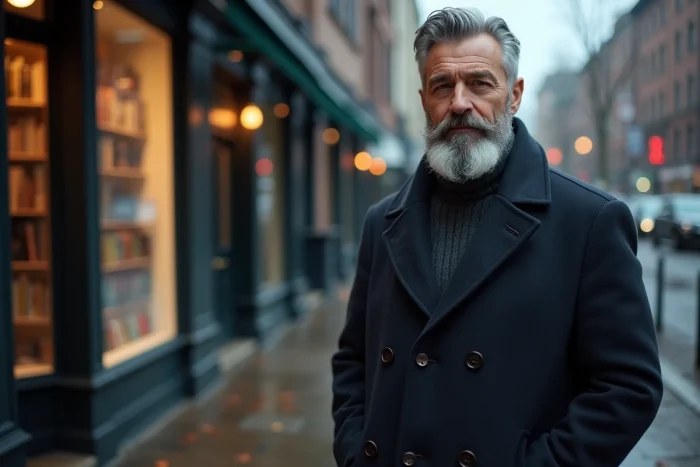
Several barbers in Paris and London reported to the Guardian (January 2025) an increase in demand for full or nearly full shaving among 25-35 year-olds, particularly in tech, design, and fashion sectors. The phenomenon is described as a direct reaction to the “beard bubble” of 2015-2020.
This movement remains a minority. Field reports vary on this point: some barbers see a real shift, while others simply note that their clients are shortening their beards without going for a total shave. The three-day beard, maintained with clean lines, occupies an intermediate position that appeals to those who want a polished look without the daily upkeep of a long beard.
Why “worked natural” is replacing raw natural
The dominant style in 2026 is neither the wild beard nor the perfectly smooth face. It is a middle ground that barbers call “worked natural”: a short to medium length, defined jawline and neck lines, but without an overly geometric effect. The goal is a look that appears spontaneous but requires regular maintenance, typically every three to five days.
This positioning explains why fades applied to beards continue to progress. The fade allows for a smooth transition between the sideburns, cheeks, and chin, giving a modern appearance without falling into the overly structured.
Solo mustache and partial styles: a confirmed niche
The solo mustache, worn without a beard, continues its progression that began a few years ago. It is no longer an ironic or retro choice: the mustache is establishing itself as a full-fledged style among a growing segment of men, especially in urban areas.
Partial styles (goatee, soul patch, mustache with soul patch) offer an alternative for men whose hair growth does not allow for a full and even beard. Rather than forcing an unsuitable style for their hair type, these men adopt shapes that highlight the areas where growth is dense.
- The chevron mustache (thick, following the upper lip) remains the most requested model in barbershops for a bold look without a beard.
- The goatee detached from the rest of the beard helps structure the chin on round or oval faces without covering the entire jawline.
- The combination of a mustache and a three-day beard works as a compromise: it adds character to the face while remaining easy to maintain.

Choosing a beard style suited to face shape in 2026
Trends mean nothing if they do not take morphology into account. A flawless fade on an elongated face can accentuate length instead of balancing it. Conversely, a very short beard on a round face may lack definition.
Round or square face: which beard styles to prefer
For a round face, styles that add definition to the chin work best. A goatee or a slightly longer beard under the chin, combined with exposed cheeks, creates an illusion of elongation. For a square face, a uniform short beard softens the angles of the jaw without masking them.
Oval or elongated face: adapting length
The oval face remains the most versatile: most beard styles adapt well to it. Elongated faces, on the other hand, benefit from avoiding long beards on the chin that accentuate verticality. A short beard with volume on the sides rebalances proportions.
Maintenance and trimming techniques: what is changing concretely
The shift towards shorter and more structured beards has a direct technical consequence: the frequency of trimming increases and precision tools become a priority. A trimmer with multiple cutting guides (from 1 mm to 10 mm) is more useful than a long beard comb.
- Daily brushing with a short-bristle brush disciplines the hair and limits frizz, even on a beard of a few millimeters.
- Beard oil remains relevant for short beards: it hydrates the skin under the hair and reduces itching, especially during regrowth.
- A precision razor or fine-blade trimmer allows for maintaining clean lines on the neck and cheeks, a gesture to be repeated every two to three days to keep the “worked natural” effect.
The beard style in 2026 is defined less by length than by the sharpness of lines and the regularity of maintenance. Long beards are not disappearing, but they are losing their status as the default choice. The criterion that distinguishes styles is now compatibility with lifestyle, whether it be professional constraints, hair type, or simply the time available each morning.