Gender Fluid Clothing: Understanding the Trend and Embracing a Label-Free Style
An oversized blazer worn with a pleated skirt, white sneakers, and zero consideration for the department from which the pieces come. This type of silhouette is multiplying on the streets, on the runways, and in shared dressing rooms. Gender fluid clothing does not refer to a marginal niche: it reflects a concrete change in how brands design, cut, and market their collections.
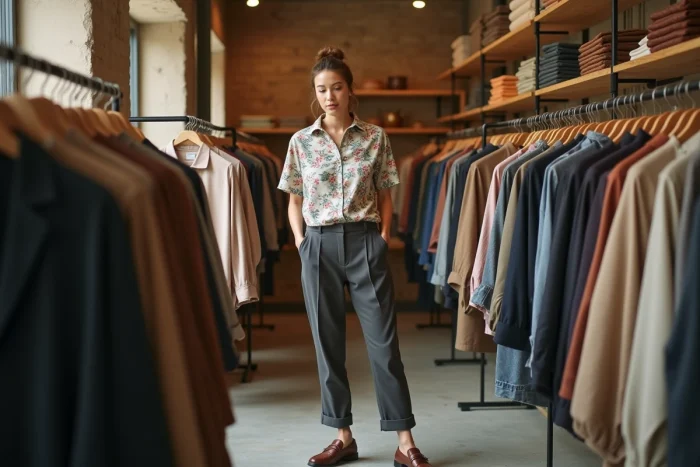
How gender fluid fashion is reshaping store displays
Have you noticed that some brands no longer separate their spaces into “men” and “women”? This is not a decorative choice. Since January 2026, French stores larger than 500 m² must eliminate gendered physical separations in their clothing sections, under penalty of fines.
This regulatory requirement accelerates a movement already initiated by several brands. The single section forces a rethink of merchandising: pieces are categorized by cut, color, or use, not by gender. For a customer, this means direct access to high-waisted pants or a long coat without having to cross a reserved floor.
The impact goes beyond layout. Classifying by cut rather than by gender changes the relationship to clothing. One chooses a drape, a material, a silhouette. The three-piece suit no longer belongs to the men’s wardrobe: it belongs to the person wearing it. To delve deeper into the fundamentals of this approach, the Recommandons site dedicated to gender fluid fashion details the definitions and pieces to prioritize.
Cuts and materials of gender fluid clothing: what really works
Talking about unisex fashion often evokes the oversized t-shirt and baggy joggers. The reality of recent gender fluid collections is more precise than that.
Structured cuts rather than loose cuts
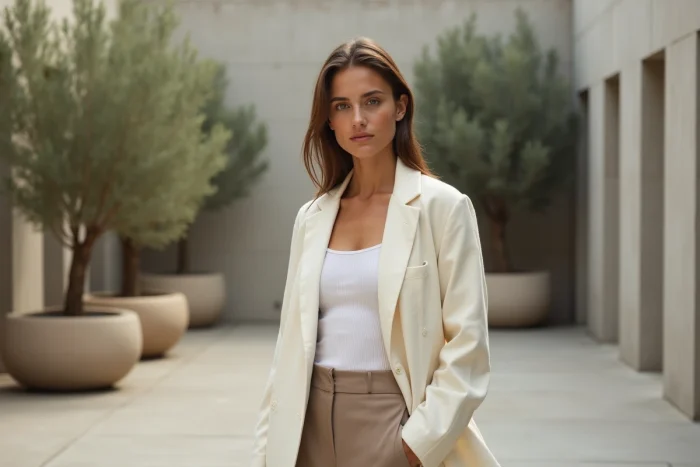
Brands succeeding in the gender fluid segment focus on structured cuts, not on “one size fits all.” A straight blazer with defined shoulders works on various body types because its line is sharp. An architectural cut adapts better than a simply enlarged cut.
The suit, in fact, becomes the central piece. Worn with an open shirt or a turtleneck, it effortlessly crosses wardrobes. The long shirt dress follows the same principle: its vertical structure suits very different silhouettes.
Technical materials and adaptive fabrics
European haute couture shows for autumn-winter 2026 have incorporated unisex thermo-reactive fabrics. These materials adjust their breathability according to body temperature, making them functional regardless of body type.
This shift towards functional sustainability distinguishes recent gender fluid collections from the early unisex attempts of the 1990s. Back then, gender-neutral clothing was merely a men’s garment offered in small sizes. Current gender fluid fashion designs clothing based on cut, not on gender.
Adopting a gender fluid style: concrete guidelines for building your wardrobe
Transitioning from a classic wardrobe to a label-free style does not require replacing everything. A few versatile pieces are enough to anchor this approach.
- The oversized blazer with structured shoulders, in wool or linen depending on the season, can be worn over jeans, a skirt, or fluid pants. It is the most versatile piece in the gender fluid wardrobe.
- The high-waisted tailored pants, cut straight, work with boots, loafers, or sneakers. Its sharp line avoids the “borrowed from someone else’s wardrobe” effect.
- The white poplin shirt, worn open over a tank top or buttoned up to the collar, fits all contexts. Choose a straight cut, neither fitted nor baggy.
- The long coat (below the knee), in wool or gabardine, provides a vertical silhouette that works regardless of what is worn underneath.
Favoring neutral colors for the basics (ecru, black, gray, navy) allows for the addition of bolder pieces without risking inconsistency. A colorful scarf, a chunky ring, or a belt with a buckle is enough to personalize the whole.
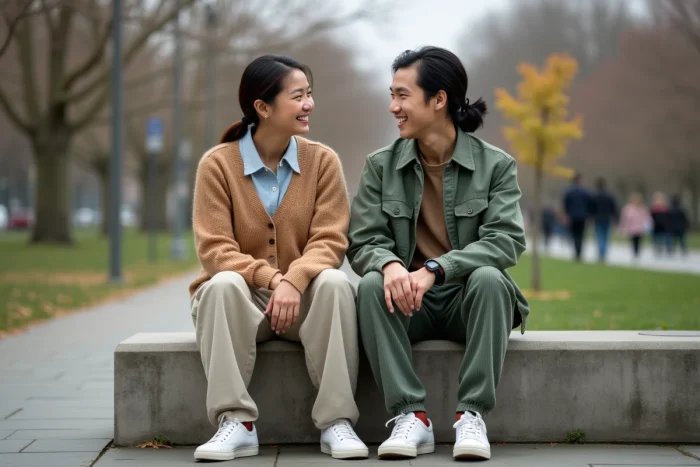
Gender fluid fashion and haute couture in Paris: what the runways show
Paris remains the most revealing observation ground for this trend. Recent couture collections multiply non-gendered proposals, and not just from young designers.
Several historic houses now present identical pieces for all genders in the same show. The dress worn by a male model is no longer a media stunt: it is a product sold, referenced, and purchased. The suit and the dress coexist in the same collection without distinction of section.
Stella McCartney, in her collaboration with H&M, emphasized the need to make fashion less elitist. This desire for democratization directly aligns with the message of gender fluid fashion: if clothing is no longer assigned to a gender, it is also no longer assigned to a price or a social circle.
Adoption in Southeast Asia, a point of comparison
The phenomenon is not limited to Europe. In Southeast Asia, gender fluid fashion is progressing more rapidly through local e-commerce platforms. Consumers there favor hybrid cultural patterns, such as modular pieces inspired by the sari or sarong. This rapid adoption shows that gender-neutral fashion adapts to local dress codes instead of erasing them.
Gender fluid clothing and everyday life: what is changing concretely
The ILGA-Europe study published in February 2026 on gender expression in public spaces reports a notable decrease in incidents of clothing-related harassment in urban areas since 2025. The normalization of non-gendered outfits in public transport and workplaces directly contributes to this.
This change does not only concern non-binary individuals. Anyone who has ever hesitated to wear a piece “not intended for their gender” benefits from an environment where clothing is judged by its cut, not by the section it comes from.
- In professional settings, gender-neutral suits simplify the question of dress codes without sacrificing elegance.
- In casual contexts, fluid pieces (wide pants, open shirts, sneakers) allow for varying silhouettes without changing the register.
- For shopping, the absence of gendered separation reduces the time spent searching for the right section and mechanically broadens the available choices.
Gender fluid fashion is not a passing trend driven solely by fashion shows. It alters the conception of clothing, the layout of stores, and the way everyone composes their outfits in daily life. The label-free style rests on a simple principle: cut takes precedence over category.