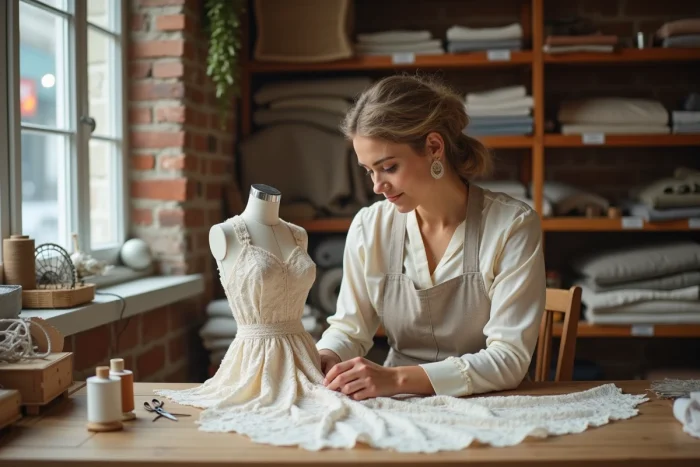
Creative Ideas and Inspirations to Succeed in Your Sewing and Lace Projects
Sewing lace means accepting to work with a fabric that forgives no approximation. A pulled thread, a needle that is too thick, or a poorly calibrated stitch, and the pattern distorts. Before looking for lace sewing project ideas, one must understand what makes this fabric so special and adjust their techniques accordingly.
Leavers lace and imported lace: choosing the right fabric to last
The longevity of a lace primarily depends on its manufacturing method. A cheap lace bought online may disintegrate after a few washes, whereas a piece salvaged from a vintage dress can last for decades without weakening.
French Leavers lace, produced on century-old mechanical looms, is gaining popularity over cheap laces. Leavers lace withstands machine washing better thanks to the complex interweaving of its threads. Lower-cost laces, often fusible, lose their shape after a few wash cycles.
For your sewing projects, this choice of fabric dictates everything else. Leavers lace can support a machine-rolled hem. A low-quality lace requires entirely handwork, or it risks tearing under the presser foot. On madame-dentelle.fr, product sheets usually specify the type of manufacturing, which helps guide your purchase even before you take out your machine.
When choosing your lace, touch it: a quality lace has a good drape and does not fray at the edge. If the edge is sharp and rigid like plastic, it is a sign of fusible bonding.
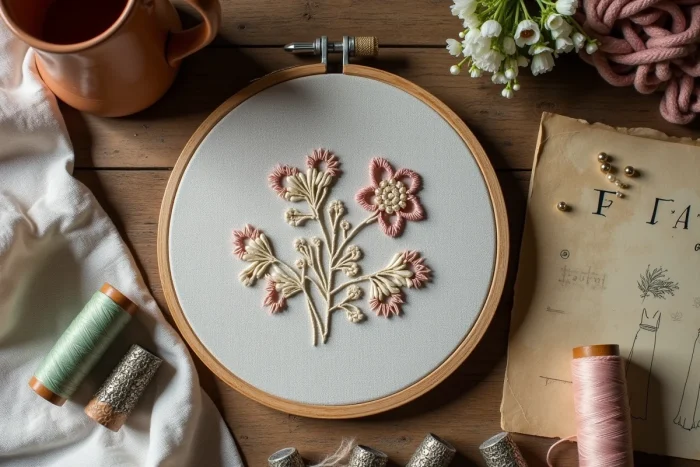
Sewing techniques suited for lace patterns
The classic trap with lace is to sew it like cotton. The open patterns slip, the fabric gets caught in the feed dogs, and the result warps.
Preparing lace before sewing
Always place the lace on tissue paper or a water-soluble stabilizer before putting it under the needle. The stabilizer dissolves during rinsing and leaves no trace. This technique prevents the fabric from getting caught in the needle plate.
Use a fine needle size 60 or 70, microtex or stretch type depending on the elasticity of your lace. A standard universal needle makes holes that are too large in delicate threads.
Stitches and machine settings for lace
- The elongated straight stitch (3 to 3.5 mm) reduces tension on the open threads and limits fabric puckering.
- The narrow zigzag stitch (width 1.5 mm) is suitable for joining two pieces of lace edge to edge without visible overlap.
- The serger with a slightly positive differential prevents stretching of stretchy lace, such as Calais lace made from elastane.
Reduce the presser foot pressure if your machine allows it. Lace needs to glide freely, not be crushed against the feed dogs.
Upcycling vintage lace: eco-responsible sewing projects
Upcycling lace garments has seen a marked increase in recent years. Eco-responsible creations from vintage textiles are multiplying, driven by the growing interest in sustainable fashion.
A lace doily salvaged from a flea market can become a removable collar for a solid-colored shirt. A lace curtain too damaged to stay in the window provides enough material for inserts on a linen dress.
Why choose this over buying new lace? Because vintage lace often has a higher thread density than current productions. The patterns are more complex, and the scalloped edges are crafted with a care that industrial fabrics do not replicate.
Before cutting a vintage piece, wash it cold in a basin with mild soap. Lay it flat on a towel to dry. Identify the weakened areas and trace your pattern pieces around them, not through them.
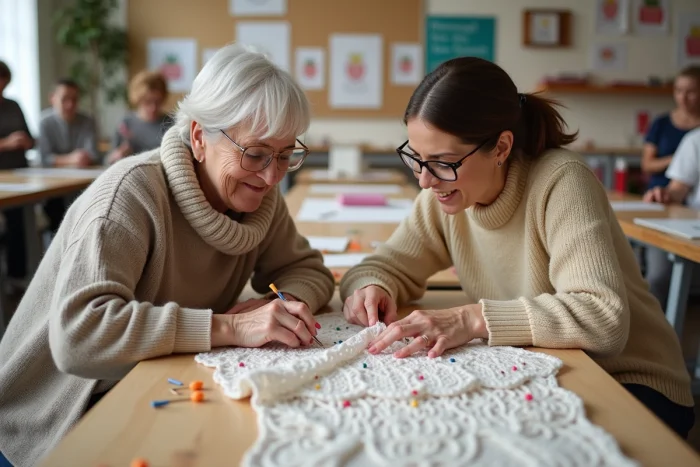
Hybrid textile-digital patterns: when 3D printing meets lace
3D printing opens an unexpected creative field for lace sewing: patterns printed in soft filament, directly integrated into the fabric. The principle is simple. A geometric pattern is printed in soft filament (TPU), then sewn or heat-bonded onto the lace.
Technical constraints to know
TPU (thermoplastic polyurethane) filament is the only one compatible with textile use. PLA, rigid and brittle, cracks at the first fold. TPU remains flexible after printing and withstands low-temperature washing.
The difficulty lies in the thickness. A print of less than one millimeter is too fragile. Beyond two millimeters, the pattern becomes rigid and pulls on the lace. The ideal zone is between these two values.
Concrete applications for sewing
- Decorative buttons printed in 3D, matching the lace pattern, attached by classic sewing with a fine thread.
- Geometric inserts sewn onto a tulle base, creating a matte/shiny contrast between the filament and the lace threads.
- Printed textile clasps or clips, replacing metal fasteners on a lace bodice.
This type of project requires a digital pattern drawn on modeling software (Tinkercad is sufficient for beginners). You export the file, print it, adjust the piece on the fabric, and sew it by hand with a discreet securing stitch.
The interest of these hybrid patterns is to personalize a creation beyond what the fabric alone allows. A lace collar with a monogram printed in TPU, a belt with soft structural elements: the possibilities remain largely underutilized by the sewing community.
Lace remains an exceptional fabric that rewards patience and precision. Whether the project starts from new fabric, a family heirloom, or a 3D file, every technical gesture should be considered in relation to the chosen fabric.