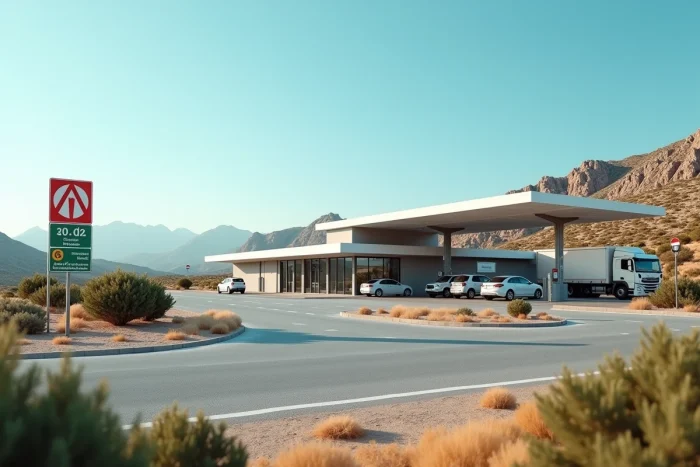
Where to find a highway rest area in Spain for a comfortable and successful trip
The Spanish motorway network covers considerable distances between the French border and the southern ports. Along these routes, rest areas are spaced at regular intervals, but their quality, safety, and services vary significantly depending on whether they are free or paid, public or private.
For travelers in motorhomes, vans, or cars, the issue of parking and resting on the motorway in Spain is not just about spotting a pictogram on a sign. User feedback from platforms like Park4Night reveals significant discrepancies between the promises displayed and the reality on the ground.
Cleanliness and reliability of free rest areas on Spanish motorways
Free rest areas along Spanish autopistas generally offer parking, toilets, and sometimes a waste disposal point for motorhomes. The problem lies in the maintenance of these facilities.
Recurring comments on Park4Night, particularly for areas located on the AP-7 or the E15, report degraded cleanliness in the free waste disposal zones. Users describe black water spills in the grids intended for gray water, making the potable water available on-site deemed unreliable by some travelers.
This type of degradation is not anecdotal. It results from intensive use by passing vehicles without control or supervision. Free areas, lacking on-site staff, become zones where individual behaviors dictate the overall condition of the facilities. To find a motorway rest area in Spain that meets a minimum level of comfort, one often has to stray from the first available stop and compare user experiences before committing.
Access to services at Cepsa rest areas on the AP-7: the hidden cost of free
Some motorway rest areas managed by oil brands like Cepsa offer additional services (showers, water, electricity). These services are not charged directly, but they are conditional.
According to descriptions published on Park4Night for Cepsa areas on the AP-7, a minimum fuel consumption is often required to access water and showers. The frequently mentioned threshold hovers around twenty euros of fuel. Without this, the stations remain locked.
This model creates an ambiguous situation. The area is technically free, parking costs nothing. However, the services that justify the stop, particularly for motorhome users, are indirectly charged. For a traveler using LPG or who has recently filled up, access to showers or water filling becomes impossible without an additional purchase.
Insecurity at free areas and environmental degradation
The least documented angle by travel guides concerns nighttime safety at Spanish free rest areas. User feedback varies on this point depending on regions and seasons, but several signals recur regularly.
Unmonitored areas, particularly those located away from service stations, concentrate issues related to:
- The absence of lighting or cameras, which increases the risk of theft from vehicles or intrusion into parked vehicles at night
- The accumulation of waste around waste disposal points, due to lack of regular collection, with a direct impact on nearby soils and groundwater
- The prolonged parking of abandoned or out-of-service vehicles, which reduces capacity and degrades the site’s image
These areas inadvertently contribute to a form of diffuse environmental degradation along Spanish motorways. Local authorities do not always have the means or competence to intervene on infrastructures that fall under the national network.
Paid secure areas near ferry ports: a developing alternative
In contrast to free areas, paid structures are emerging near major Spanish ports (Algeciras, Tarifa, Barcelona). These areas primarily target travelers in motorhomes or vans waiting for a ferry to Morocco or the Balearic Islands.
Their model is based on a nightly rate that includes:
- A designated spot with electricity and Wi-Fi access
- Sanitary blocks maintained daily, with hot showers
- Nocturnal supervision or a fenced area with code access, limiting intrusions
- Waste disposal stations compliant with standards, separating gray and black water
Examples like the Camping-Car Park in Frias in Castile and León or private areas listed on areasautocaravanas.com show that the secure paid model is gaining ground against degraded free areas. The rate remains modest compared to a traditional campsite, and proximity to the ports represents a strong logistical argument for crossings to North Africa.
The role of collaborative platforms in choosing rest areas
Park4Night, CaraMaps, and specialized sites like areasautocaravanas.com allow filtering of areas by available services, user ratings, and date of the last review. This layer of information changes how travelers prepare their stops.
A review dating back more than a year on a free area may mask recent degradation. Conversely, a recently opened paid area may not yet appear on all platforms. Cross-referencing multiple sources remains the most reliable method to evaluate an area before stopping there.
Regulation of parking in motorhomes at Spanish rest areas
Spain distinguishes between parking (the vehicle is parked, no camping) and camping (awning deployed, table out, visible chocks). At a motorway rest area, only parking is allowed. Municipalities can penalize any behavior akin to wild camping, even at a public area.
This distinction explains why some free areas display restrictive signs that seem contradictory: parking is free, but prolonged installation is prohibited. Private paid areas circumvent this problem by offering a clear contractual framework, with published usage rules (like those of Mas Bordas or Exstoso Motorhome Parking, listed on Park4Night).
The choice between free and paid areas in Spain depends on the expected level of comfort and security, but also on the duration of the stop. For a daytime break of a few hours, a well-rated free area suffices. For a full night before a ferry embarkation, the available data tends to lean towards structured facilities, where the tranquility of parking is part of the service.