
Discover how to assess and improve your walking speed for better health
The average walking speed of a healthy adult is around 4 to 5 km/h. The speed at which a person walks reflects the combined state of their muscular, cardiovascular, and neurological systems. Assessing one’s walking speed and then seeking to improve it involves acting on several health levers simultaneously.
Walking Speed and Functional Reserve: What Pace Really Measures
Walking speed does not only inform about apparent physical condition. A meta-analysis from 2024 (Doi T. et al., Journal of Gerontology: Medical Sciences) showed that among individuals with an equivalent number of daily steps, older adults walking faster had fewer hospitalizations for avoidable cardiovascular and respiratory causes. Therefore, the volume of activity alone is not sufficient: walking speed reflects the overall functional reserve of the body.
This concept of functional reserve refers to the body’s ability to respond to unexpected exertion or physiological stress. An individual capable of walking at a sustained pace effectively mobilizes their muscles, breath, and balance, three functions that decline with age or sedentary behavior.
To delve deeper into the relationship between walking pace and health indicators, you can read the health article from Valbreon that details the thresholds to know based on age.
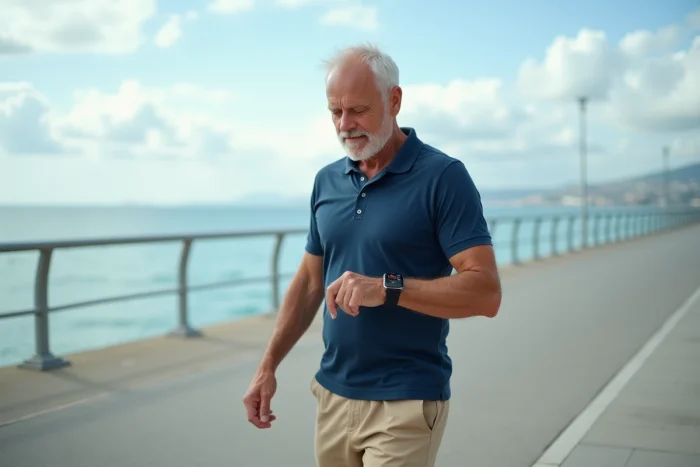
Assessing Your Walking Speed: Simple Protocol and Thresholds to Know
Measuring your pace does not require expensive equipment or laboratory tests. The most commonly used protocol in clinical settings involves timing the duration needed to cover a fixed distance, usually a few meters on flat terrain, at your natural pace.
How to Proceed on the Ground
- Choose a flat and clear section (a hallway, a straight sidewalk) and measure a precise distance with a tape measure or a GPS app.
- Walk at a normal pace, without trying to speed up or slow down. The timer starts with the first step on the starting line.
- Repeat the measurement two or three times and take the average to smooth out variations related to fatigue or concentration.
The speed obtained by dividing the distance by the time gives a result in meters per second or in km/h. In geriatrics, a threshold below 0.8 m/s is often associated with an increased risk of frailty. This benchmark, used in frailty assessment grids, is also applied in cardiac surgery to refine the estimation of surgical risk (Afilalo et al., JACC Advances, 2023).
For a younger adult, the goal is more about the ability to maintain a sustained pace over an extended duration. Consistency is as important as peak speed.
Strengthening Lower Limbs: The Underestimated Lever
Most walking advice focuses on volume (number of steps, duration of the outing). The angle most documented by recent research is different: strengthening the leg muscles improves walking speed even without walking more.
A randomized controlled trial from 2023 (Beijersbergen et al.) conducted with adults aged 60 to 80 compared two groups. The first followed a strengthening program targeting quadriceps, hamstrings, and glutes, with two to three sessions per week, without instructions to increase walking time. The second group only practiced walking. The strengthening group progressed more in both usual and fast walking speed.
Three Accessible Exercises to Gain Power
Bodyweight squats, step-ups, and glute bridges form an effective foundation. Two to three sets of ten to fifteen repetitions, twice a week, are sufficient to observe measurable progress within a few weeks for a sedentary person.
The physiological explanation lies in stride length and propulsion strength. A stronger muscle generates a more forceful push against the ground, which naturally lengthens the stride without additional conscious effort. The stride lengthens as propulsion strength increases, and speed progresses mechanically.
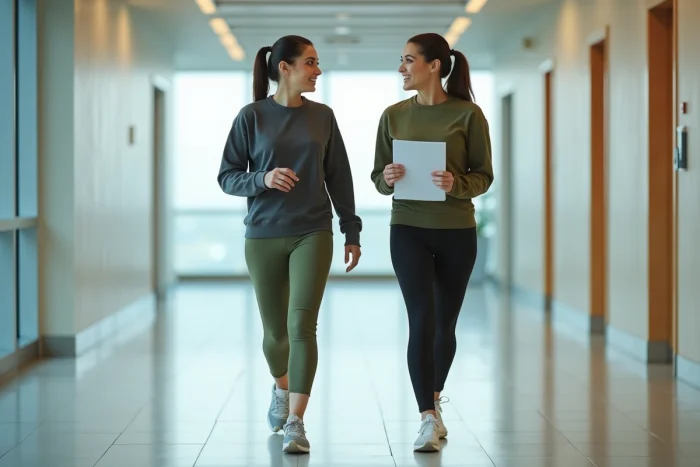
Adapting Walking Speed Progression According to Age
Walking speed naturally declines with age. Steps become shorter, coordination less fluid, and posture loses verticality and flexibility. This decline is not linear: it accelerates after a prolonged period of inactivity, hospitalization, or a fall.
For an active adult between 30 and 50 years old, a realistic goal is to maintain a fast walking pace (beyond the natural rhythm) for sessions of twenty to thirty minutes, several times a week. Nordic walking, which also engages the upper body with poles, offers a more complete workout and allows for a higher cadence with a lower perceived effort.
After 65, the priority shifts to maintaining usual speed and preventing frailty. The muscle strengthening described above then becomes crucial. Combining balance exercises (heel-to-toe walking, single-leg support) with the strengthening routine reduces the risk of falling while supporting pace.
When to Consult
A notable decrease in walking speed over a few months, without an obvious cause like an injury, warrants medical advice. This slowdown may signal a cardiac, neurological, or joint issue that deserves specific evaluation rather than just encouragement to walk more.
The pace at which you cover your daily route summarizes, better than many tests, your body’s ability to function under moderate exertion. Working on your walking speed through muscle strengthening, adapting your practice to your age, and monitoring any unexplained decline are three concrete approaches that require neither a subscription nor equipment, just a few sessions per week and a bit of consistency.