Understanding the meaning and difference between ASH and ASHQ in the medico-social sector
The acronym ASH refers to a hospital service agent, while ASHQ adds the qualifier “qualified” to this role. Both work in health or medico-social establishments (hospitals, nursing homes, care homes), but their status, missions, and regulatory framework do not completely overlap. Understanding this distinction helps to better grasp the professional pathways available in the public hospital service.
Regulatory Limits of ASH: What the Law Prohibits
Before detailing the differences in status, a legal point structures the entire profession. ASHs cannot administer medications, even under supervision. A recent court ruling confirmed this prohibition, relying on the decree of August 3, 2007, and the Public Health Code.
This framework explicitly excludes ASHs from collaborative acts with nurses for administering treatments. This limit also applies to ASHQs: the qualification does not confer any additional medical competence.
This regulatory boundary is often a source of confusion in nursing homes, where the lack of nursing staff sometimes leads to requesting service agents for tasks that exceed their scope. To delve deeper into the meaning and difference between ash and ashq, the legal framework remains the primary distinguishing criterion.
ASH and ASHQ in Public Hospital Service: Status and Access to the Corps
ASH is a generic term that covers hospital service agents, whether they are contractual or permanent. ASHQ specifically refers to the permanent civil servant of the corps of qualified hospital service agents, belonging to category C of the public hospital service.
Access to the ASHQ corps is done without a competitive exam, through direct recruitment. No diploma is required, although a CAP in hygiene, cleanliness, or collective catering facilitates the application.

The concrete difference between a contractual ASH and a permanent ASHQ lies on several levels:
- Job stability: the permanent employee benefits from the security of civil servant status, with a career progression based on a pay scale
- Compensation: the ASHQ progresses through steps, with salary increases linked to seniority, whereas the contractual employee remains on a fixed or minimally evolving salary
- Social rights: access to CGOS benefits, specific retirement scheme of the public hospital service
An ASH on a fixed-term contract or temporary assignment can perform exactly the same tasks as a permanent ASHQ. The difference does not lie in the content of daily work, but in the administrative framework and long-term prospects.
Daily Missions: Hygiene, Bio-Cleaning, and Support
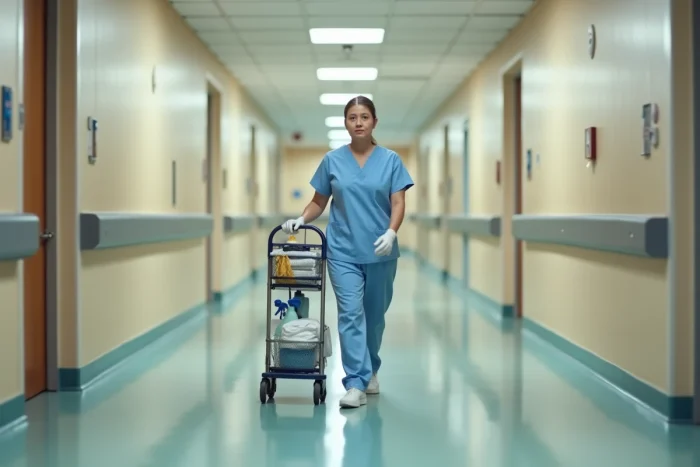
The common foundation of missions is based on the maintenance and hygiene of premises: cleaning rooms, disinfecting surfaces, managing laundry, maintaining common areas. In a hospital setting, these tasks fall under bio-cleaning, which follows strict protocols to limit nosocomial infections.
Depending on the assigned service, the missions expand. In nursing homes, the agent often participates in meal distribution, assists in the dining room, and sometimes accompanies residents in their movements. These relational tasks represent a significant part of daily life, especially in smaller facilities.
Specialization depends on the establishment, not on the ASH or ASHQ status. An ASHQ assigned to hospital laundry and a contractual ASH in a nursing home do not have the same daily job, even though their job description falls under the same corps.
Job Market Tensions in Nursing Homes: Experience Required and Candidate Shortage
Job offers for ASHQ positions in nursing homes frequently require a minimum of one year of experience. This prerequisite creates a paradox: establishments struggle to recruit while filtering out candidates who could be suitable after a short adaptation period.
On France Travail platforms, recent ads illustrate this tension. Some offers combine the ASHQ position with nursing assistant reinforcement missions, further blurring the boundary between jobs. These hybrid positions expose agents to task shifts towards care acts that do not fall under their regulatory competence.
For candidates without experience, several entry pathways exist despite these requirements:
- Temporary missions through agencies specialized in the medico-social sector, which allow accumulating experience through short replacements
- Subsidized contracts or immersion internships offered by France Travail, which provide access to the field without seniority conditions
- Direct applications to small associative nursing homes, often less demanding on experience than hospital centers
Evolution Towards the Nursing Assistant Profession
The most common pathway for an ASHQ wishing to expand their skills remains the nursing assistant training in IFAS. This program opens access to supervised care acts and significant salary enhancement. Permanent ASHQs can benefit from professional promotion schemes funded by their establishment.
This evolution also meets the needs of nursing homes, which seek to strengthen their nursing teams. Transitioning from ASHQ to nursing assistant allows remaining in the same establishment while changing corps and pay scale.
The distinction between ASH and ASHQ, often perceived as an administrative nuance, actually conditions access to permanent status, statutory rights, and continuing education schemes. For agents in position as well as for candidates, it is the status of permanent ASHQ that opens the most structured career prospects in the medico-social sector.