
Yoga changes physiology far beyond joint flexibility. Its effects on the autonomic nervous system, cortisol regulation, and brain plasticity make it a practice whose mechanisms deserve technical examination. Understanding how yoga transforms body and mind on a daily basis requires going beyond commonplaces about relaxation to delve into the details of neuromuscular and metabolic adaptations.
Regulation of the autonomic nervous system through breathing yoga
Controlled slow breathing (pranayama) directly affects vagal tone. Lengthening the exhalation stimulates the vagus nerve, which lowers heart rate and reduces blood pressure in a measurable way from the very first session. This mechanism distinguishes yoga from most sports practices, where breathing remains secondary to muscular effort.
We observe that pranayama modifies the sympathetic-parasympathetic balance within minutes. Techniques such as alternate nostril breathing (nadi shodhana) or complete abdominal breathing shift the balance towards the parasympathetic mode, reducing cortisol and adrenaline production.
This point has concrete implications for daily stress management. A meta-analysis of randomized trials involving stressed adults, with research concluded in May 2024, shows that the psychological benefits of yoga are not necessarily superior to those of other physical activities.
The difference lies in accessibility: five to ten minutes of controlled breathing is sufficient, without any equipment or prior physical condition. Several accessible publications on the Les Jardins Du Yoga website detail these breathing protocols tailored to different levels of practice.
Yoga postures and musculoskeletal adaptations
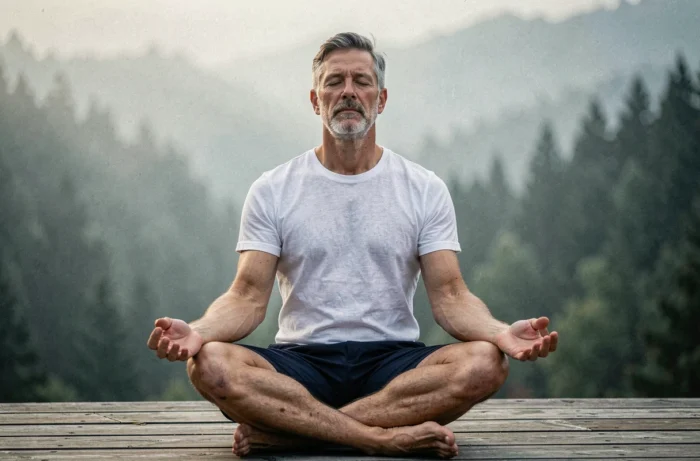
Asanas are not just passive stretches. Each posture engages complete muscle chains in isometric or eccentric contraction. Prolonged holding of Warrior II (virabhadrasana II) simultaneously activates the quadriceps, hip abductors, and shoulder stabilizers.
Yoga develops functional strength without external load. Balance postures (tree, eagle, half-moon) recruit the deep trunk and ankle muscles, groups often neglected by traditional weight training. This proprioceptive engagement reduces the risk of falling and improves motor coordination.
From a joint perspective, spinal twists maintain hydration of the intervertebral discs through a mechanical pumping mechanism. Forward bends and back extensions work on the segmental mobility of the spine, a parameter that naturally declines with age and sedentariness.
- Standing postures (warrior, triangle) target the muscles of the lower limbs and core stability, with marked eccentric work on the hamstrings.
- Inversions (shoulder stand, headstand) alter venous return and stimulate lymphatic drainage, which can relieve heavy legs.
- Backbends (cobra, bridge) strengthen the spinal erectors and open the chest, improving respiratory capacity.
We recommend varying the families of postures within each session to engage all myofascial chains. A sequence focused solely on flexibility will not produce the same adaptations as a balanced sequence including strength, balance, and mobility.
Effects of yoga on sleep and concentration
Meditation combined with postures improves sleep quality more than duration. Yoga nidra, a guided relaxation practice in a lying position, reduces sleep onset latency by acting on brain wave activity. The smooth transition to alpha and then theta waves prepares the way for deep sleep.
Regarding concentration, regular practice of dharana (fixing attention on a single point) strengthens prefrontal attentional circuits. Unlike mindfulness meditation, which welcomes all stimuli, dharana imposes an effort of sustained focus, akin to targeted cognitive training.
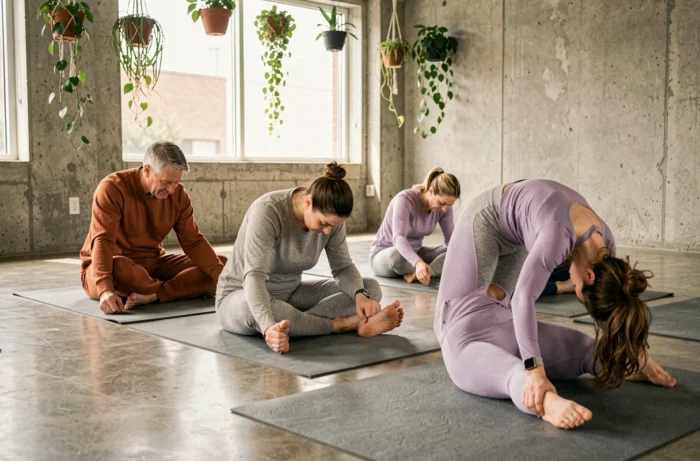
In practice, we find that a daily yoga session, even if short, stabilizes the circadian rhythm. The body associates the sequence of postures-breathing-meditation with a regulatory signal, helping individuals with mild sleep disturbances to regain a more regular cycle.
Yoga and digestive disorders: what recent data shows
A systematic review published in 2024 by Thakur et al. in Neurogastroenterology & Motility examined yoga as support for gastrointestinal disorders. The results are promising for digestive symptoms and quality of life, but the authors highlight the small size of the studies, their often short follow-up, and the heterogeneity of the practices analyzed.
This finding tempers frequent claims about yoga as a solution for digestive problems. Abdominal twists and compression postures (pavanamuktasana) do exert a mechanical action on peristalsis, but their isolated clinical effectiveness remains to be confirmed by larger trials.
The respiratory component likely plays a role via the gut-brain axis. Vagal stimulation through pranayama influences gastric motility and the secretion of digestive enzymes. This is a documented physiological mechanism, but yoga does not replace gastroenterological treatment for diagnosed pathologies.
Heated yoga and misconceptions about performance
Hot yoga (practiced in a heated room) is gaining popularity. A systematic review published in 2025 concludes that heated yoga has not demonstrated a superior benefit compared to non-heated yoga or traditional exercise. The heat increases the sensation of flexibility through vasodilation and temporary muscle relaxation, without additional structural gain on connective tissues.
The risk of dehydration and hyperthermia is real, particularly for beginner practitioners or those on antihypertensive medication. We advise against heated yoga as an entry point into the discipline. Practicing at room temperature offers the same physiological adaptations with a much wider safety margin.
The choice of yoga style (hatha, ashtanga, vinyasa, yin) matters more than the ambient temperature. A rigorous ashtanga practice at normal temperature will challenge the cardiovascular and muscular systems more intensely than a hatha class in a heated room. Adaptation should be made according to individual goals: strengthening, recovery, stress management, or rehabilitation.
Regularity takes precedence over intensity. A few minutes of daily practice produce more stable neurovegetative adaptations than a long weekly session. Yoga transforms body and mind through the accumulation of moderate stimuli, not through isolated peaks of effort.