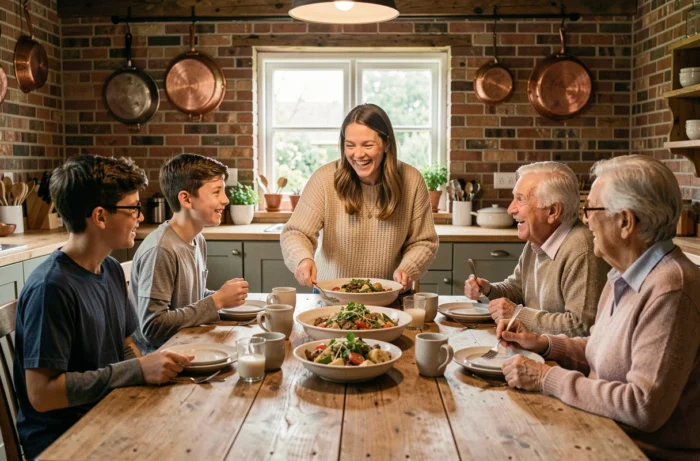
Time spent with family is not just an accumulation of activities. Recent research on parenting shows that the quality of presence matters more than the quantity of hours shared. Between parental technoférence (the interference of adult screens in family interactions) and the difficulty of carving out time outside of work constraints, building a fulfilling family life requires concrete choices, not just good intentions.
Parental technoférence: the blind spot of screens in the family
Articles about family life often discuss children’s screen time. The less addressed topic is that of the parents’ own screens. A longitudinal study reported by CB News in September 2026, based on Bayard Jeunesse data, highlights a paradox: parents express concern about digital devices while using screens to occupy or calm their child.
This phenomenon has a name in the scientific literature: technoférence. A parent checking their phone during a meal or conversation interrupts the flow of communication. The child perceives this break in attention, even if it is not verbalized.
For those who wish to explore practical resources on parenting and family activities, it is possible to discover the Jolie Family website which gathers various content on these topics.
The French inter-ministerial report “Children and Screens, in Search of Lost Time,” submitted in April 2024, emphasizes co-use rather than a blanket ban. Watching or playing with the child, commenting on what is happening on the screen, and suggesting an alternative: this approach is considered more relevant than a simple uniform time limit for all ages.

Family activities: what truly creates lasting moments
Online lists of family activities are plentiful. However, feedback from the field diverges on this point: it is not the nature of the activity that anchors a memory, but the degree of shared involvement. Cooking a simple dish together leaves a stronger mark than a trip to an amusement park where everyone looks in a different direction.
Nature activities and DIY games
Outdoor activities (hiking, gardening, insect observation) have a structural advantage: they effortlessly eliminate screens from the equation. No need for rules or negotiation; the context does the work.
DIY games made as a family (cardboard forts, obstacle courses in the garden, herbariums) offer two benefits. The child participates in creation, not just consumption. And the process of making generates spontaneous exchanges that “ready-made” activities do not always provoke.
- A weekly cooking workshop where each family member takes turns choosing a recipe creates a ritual without excessive rigidity
- Regular nature outings (even short ones, even close to home) provide a conducive setting for conversation between parents and children
- Collective creative projects (mural painting, photo album, vegetable garden) give a common goal that goes beyond mere time occupation
Work-life balance: concrete measures in France
A fulfilling family life also depends on material constraints. In France, several measures allow for parental time, but their use often remains poorly known or underutilized.
Parental leave and parental presence leave
Parental education leave allows for the suspension or reduction of professional activity after the birth or adoption of a child. Eligibility conditions, duration, and compensation vary depending on the employee’s situation. The PreParE (shared child education benefit) can partially compensate for lost income, but its amount remains modest.
The lesser-known parental presence leave is aimed at parents whose child has a serious illness or disability. It offers flexibility in organizing time, with a number of days that can be split over several years.
Daily reconciliation: beyond legal rights
Rights exist, but reconciling professional and personal life remains a constant balancing act. Telecommuting has opened up possibilities while blurring the boundaries between office and home. A parent working from their living room is not necessarily more available for their children than a parent at the office, if presence times are not clearly delineated.
- Identifying two or three non-negotiable time slots during the week (dinner time, weekend outing, reading time) protects family time from professional emergencies
- Explicitly communicating with one’s employer about parental constraints facilitates work schedule adjustments
- Alternating roles within the couple (who manages homework, who prepares dinner, who accompanies to activities) prevents one parent from becoming overwhelmed
Family happiness and communication: what the data suggests
The notion of happiness in the family is difficult to measure. Surveys by Santé publique France, notably the Enabée study published in 2025, explore children’s well-being in relation to their family and school environment. Sleep, physical activity, and the quality of parental interactions emerge as determining factors.
The available data do not allow for concluding that a single family model guarantees flourishing. However, certain markers consistently recur: the regularity of shared moments, active listening (asking open-ended questions rather than “how are you?”), and the ability of parents to recognize their own limits without guilt.
The inter-ministerial report of 2024 also highlights that screen time significantly increases on days without school. This observation invites a rethink of weekend and vacation organization, not by overloading them with activities, but by planning periods where boredom becomes possible. Boredom remains a trigger for creativity in children, provided that the alternative is not immediately a screen.
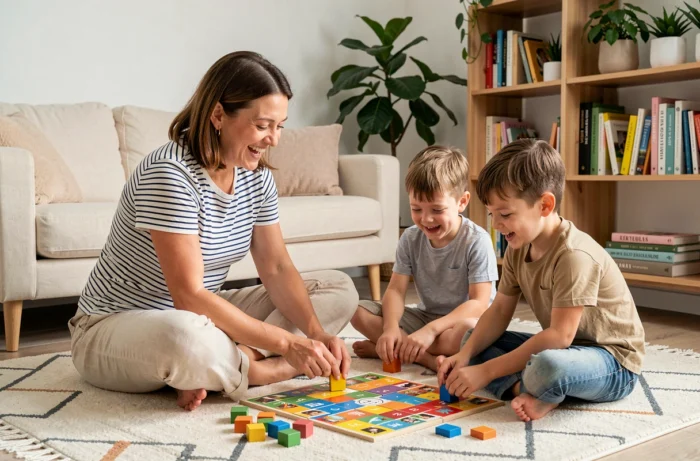
Building memorable family moments does not require a substantial budget or a perfect schedule. Attentive presence, even if brief, matters more than duration. Fifteen minutes of board game play without a phone in reach is likely worth more than an entire afternoon where attention is scattered.